
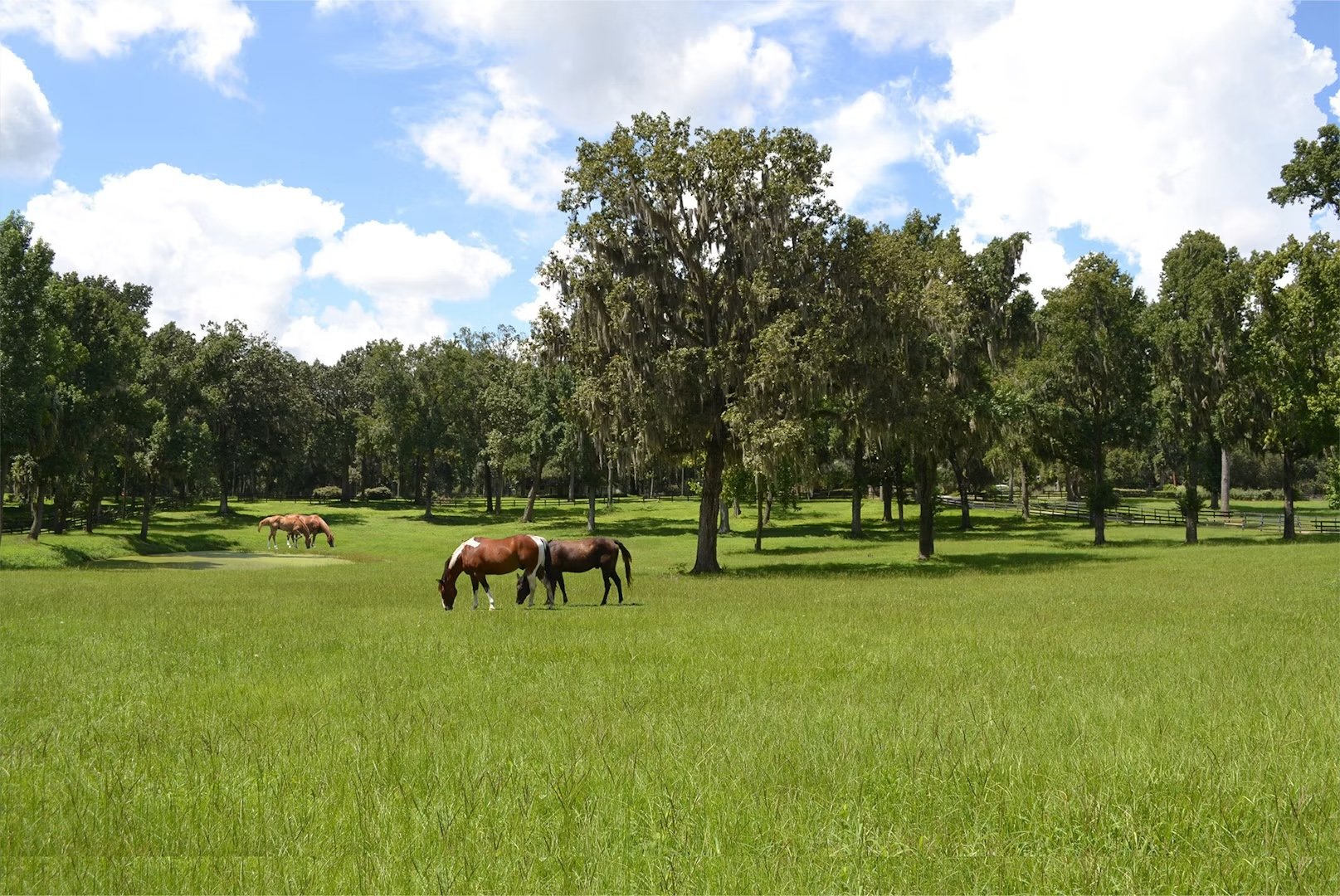
Horse farms still make up large sections of northwest Marion County, where a new master plan seeks to preserve its equestrian character as the county grows. Photo by Ocala/Marion County Visitors and Convention Bureau.
Marion County and its largest city, Ocala, might be known as the Horse Capital of the World, but its affordability and robust job market have led to a new moniker: the fastest growing metropolitan area in the United States, according to the U.S. Census Bureau.
The North Central Florida county has grown every year since the turn of the century. But over the last decade, the population has exploded by more than 29%, with nearly 14,700 people moving into Marion County from 2024 to 2025 alone. As the population grows, so does the need for greater investment in infrastructure to keep pace with the growth.
Creating a Vision for the Northwest Gateway Community
Earlier this month, Marion County hosted a public workshop, called a charrette, to engage citizens in developing a master plan to shape the future of its Northwest Gateway Community, home to the World Equestrian Center and Golden Ocala Golf and Equestrian Club. The goal of the master plan is to preserve the equestrian character as the County continues to grow.
Hosted by the County in partnership with Kimley-Horn and Dover, Kohl & Partners, the public browsed project visualizations, reviewed project data and shared their visions for the community with the design team. The County also held tabletop engagement sessions and presentations, seeking public input to relieve potential stress points.
The findings from this interactive process will be paired with market analysis of the County’s land use and development to form a strategic investment plan and capital improvement program.
Expanding Capacity for Drinking Water and Wastewater
The 2026-2030 capital improvement plan adopted by the Marion County Board of Commissioners includes several projects to meet the growing demand for safe drinking water and wastewater services in booming residential communities across the County.
The County received a federal Community Development Block Grant to eliminate hundreds of failing septic systems in Silver Spring Shores, a community of more than 11,000 homes southeast of Ocala. The County allocated $46.1 million from the federal American Rescue Plan Act (ARPA) to implement this septic-to-sewer program that will connect hundreds of properties to a centralized collection and treatment wastewater system, which will reduce harmful pollution across the Silver Springs watershed.
The first two phases of the four-phase project will connect 861 residences across 429 acres. The project includes the installation of sewer collection systems, force mains, lift stations and water distribution infrastructure, modernizing the area’s utility service. The final two phases represent approximately 480 acres and 998 lots or properties, and both phases are subject to final approval and funding.
The County has also allocated another $10 million for water line extensions in Marion Oaks, a growing community of more than 7,000 homes in Southwest Marion County. Another $2.4 million is earmarked for water and sewer extensions near State Road 200 and Southwest 60th Avenue in Ocala.
County officials are also taking steps to prepare for future growth. In April, Tillman and Associates Engineering, LLC entered a special-use permit application on behalf of the County to relocate and expand the Salt Springs Water Treatment Plant. Rather than expanding its current location on land owned by the U.S. Forest Service, the plant will be moved a mile northwest to an 8.75-acre plot of County-owned land.
In addition, the project will expand supply, storage and resiliency with an additional well, two 10,000-gallon storage tanks, a standby generator and 200-square-foot control building.
Easing Road Congestion
The Florida Department of Transportation (FDOT) is currently working on a dozen projects in Marion County aimed at building capacity and improving safety.
A 4.1-mile stretch of U.S. 41 will soon be widened to increase capacity and improve roadway operations. RS&H is leading design on the project estimated at $52.8 million, which spans from Southwest 110th Street to north of State Road 40 and also introduces a new sidewalk and paved shoulders.
Interstate 75, which traverses the County, is seeing big changes, too. FDOT is expanding 30 miles of I-75 from South of State Road 44 to State Road 326, adding an auxiliary lane in each direction and multiple bridge and interchange replacements and enhancements. According to FDOT projections, these auxiliary lanes are expected to reduce travel delays by 96% in the northbound direction and 88% in the southbound direction.
A bit south of State Road 326, FDOT tapped Lane Construction Corp. to construct a diverging diamond interchange (DDI) for a new exit off I-75 at Northwest 49th Street in Ocala. The DDI will provide relief for the new interchange and a new Buc-ee's travel center that will connect to it.
The DDI will eliminate left turns across oncoming traffic, while additional infrastructure will support bicyclists, pedestrian crossings, sidewalks and multi-use paths for non-vehicular traffic. Those features will undoubtedly ease some of the traffic concerns that arise when the Buc-ee’s convenience store moves into town.
The Marion County Buc-ee’s location will feature an 74,000-square-foot building alongside 120 fueling stations, 28 electric vehicle charging stations and 750 parking spots. The store will serve the county’s growing population in addition to the millions of visitors who drive through the state annually.