
A Monumental Engineering Feat: Saving the Iconic Shark Channel Bridge
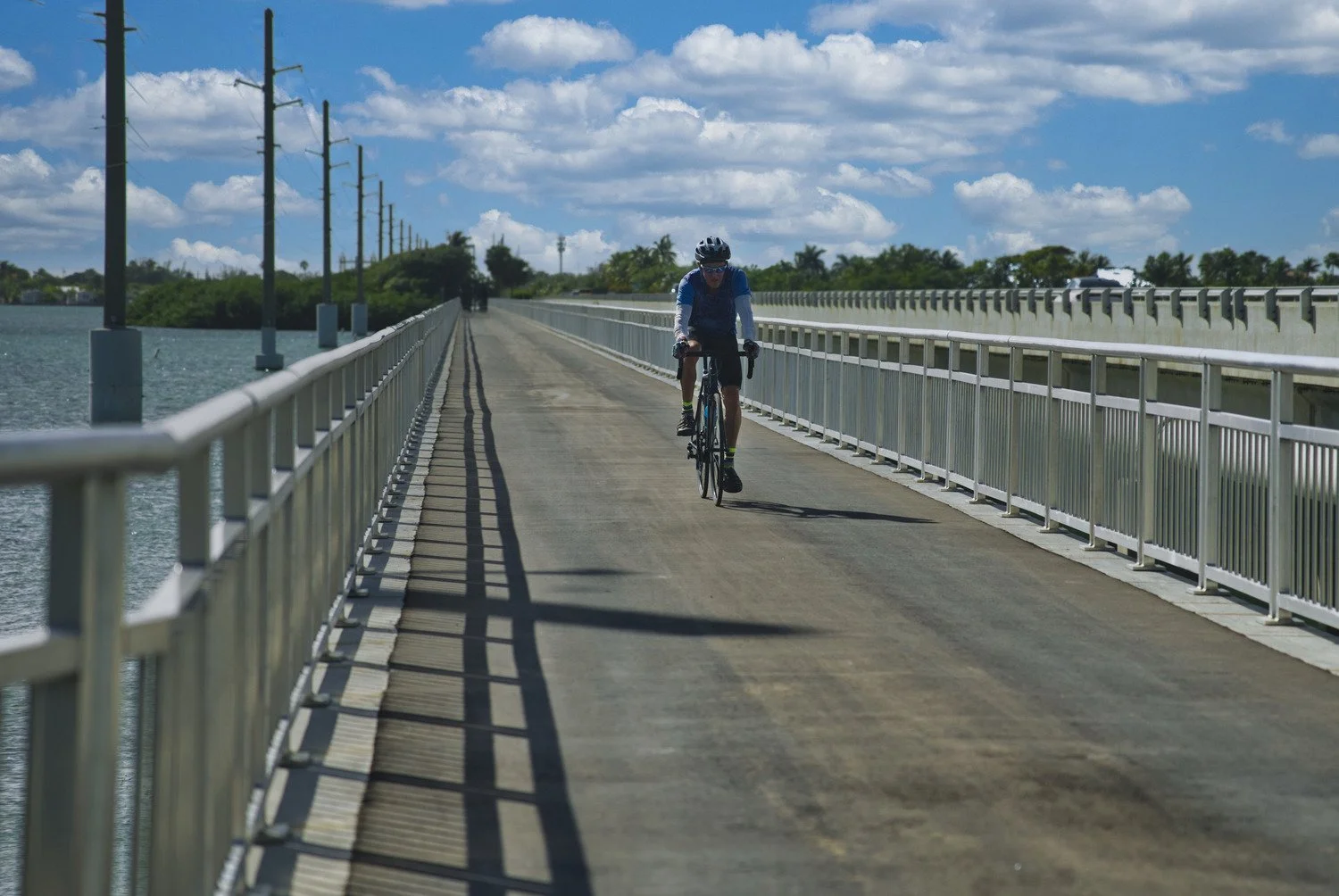
Cyclists ride over the renovated Shark Channel Bridge. Thanks to meticulous planning and seamless collaboration among engineers, environmental authorities, and historic preservation specialists, the Shark Channel Bridge reopened in November 2025. Photo provided by Gresham Smith.
Thanks to generations of engineers, the Shark Channel Bridge is experiencing new life more than a century after it was originally designed and built. The bridge, just north of Key West, once provided a critical connection for the historic Florida East Coast Railroad and subsequently for the Overseas Highway.
Today, it serves as a key connector for Floridians and tourists walking, biking and sightseeing along the scenic Florida Keys Overseas Heritage Trail. Now newly renovated, the 124-year-old bridge continues to stand as testament to one of the state’s signature engineering feats.
Bridging the Vision from Miami to Key West
Inspired by the opening of the Panama Canal and expanded global trade routes, industrial visionary Henry Flagler embarked on a monumental quest: to connect Miami and Key West by railroad. Once dismissed as impossible, Flagler’s relentless determination made the Florida East Coast Railroad a reality.
This unparalleled engineering feat required constructing nearly 100 bridges and utilizing an astounding 17 million cubic yards of fill material to weave together the scattered islands of the Florida Keys. Completed in 1912, shortly before Flagler’s passing, the railroad served as a critical transportation lifeline for more than two decades. Then, the catastrophic 1935 Labor Day Hurricane, compounded by the financial hardships of the Great Depression, led the railroad company to end operations on the oversea route.
But the devastating natural disaster couldn’t destroy the value of the landmark transportation corridor. By 1938, the Florida Department of Transportation (FDOT) and Monroe County had repurposed the railroad’s right-of-way into the Overseas Highway, ingeniously adapting the original concrete-filled spandrel arch bridges for automobile traffic by adding steel beams and concrete cantilever widenings.
As vehicular traffic surged and the original bridges succumbed to wear, FDOT developed a parallel highway system, U.S. 1, to alleviate pressure on the historic structures. Again, the bridges were too valuable to abandon and the railroad corridor was reborn in 1997 as the Florida Keys Overseas Heritage Trail, safeguarding the iconic concrete arch bridges and earning a prestigious place on the National Register of Historic Places.
Over time, structural deterioration forced the closure of many bridge sections, demanding intricate preservation strategies to maintain accessibility and honor the trail’s historic significance.
Shark Channel Bridge’s Urgent Preservation
Nestled near milepost 11 just north of Key West, the Shark Channel Bridge stretches 1,988 feet, composed of 97 concrete-filled spandrel arch spans. In April 2022, critical safety inspections uncovered failing cantilevers, prompting immediate closure.
Entrusted by the Florida Department of Environmental Protection (FDEP), Gresham Smith undertook comprehensive structural inspections and crafted a preservation plan focused exclusively on rehabilitating the bridge for pedestrian and cyclist use—balancing safety imperatives with historic conservation.
Navigating Security and Structure: Inspection Innovation
The bridge’s location adjacent to a naval air station introduced stringent security restrictions, barring drone flights and limiting close inspections of the heavily compromised deck overhangs and cantilevers. While inspectors could access the main concrete bridge deck, the most vulnerable sections remained unreachable from above.
To overcome these barriers, the inspection team innovatively employed kayaks and water-based methods, ensuring a meticulous assessment of all repair needs while adhering to strict security protocols. This nuanced evaluation weighed the costs of rehabilitation against preservation of the bridge's historical and structural essence.
Collaborative Stewardship
Environmental protection is a cornerstone of the project’s philosophy. The Florida Division of Historic Resources, the South Florida Water Management District (SFWMD) and the Florida Keys National Marine Sanctuary (FKNMS) provided regulatory oversight, with critical input from the U.S. Army Corps of Engineers (USACE).
Their vigilance focused on preventing debris from contaminating the fragile marine ecosystem during demolition while safeguarding the bridge's historic character. At every design and planning stage, proposed methods underwent rigorous review by these entities to ensure meticulous adherence to environmental and preservation standards.
Restoring the Shark Channel Bridge
Gresham Smith’s preservation strategy emphasized restoring the bridge’s original architectural form by removing the later FDOT-installed vehicular cantilevers. The plan included the installation of standard FDOT pedestrian railings suitable for cyclists, harmonizing with other regional structures and satisfying environmental concerns.
Key construction activities encompassed repairing essential weep holes vital for draining the filled spandrel arches, delicately injecting concrete cracks without polluting the National Marine Sanctuary waters, and replacing both the bridge deck and concrete arch facias to prevent water infiltration and support the new safety railings.
A New Chapter: Construction and Revival
Jones Benetiz Construction brought valuable expertise in demolition techniques designed to minimize ecological impact. Thanks to meticulous planning and seamless collaboration among engineers, environmental authorities, and historic preservation specialists, the Shark Channel Bridge reopened in November 2025.
This restoration revives a treasured emblem of Florida Keys heritage—ensuring it remains a vibrant corridor for pedestrians and cyclists, cherished by generations to come.
Fadi Alsharif, P.E., is a senior engineer in Gresham Smith’s Bridge Transportation department, with almost two decades of experience providing construction, engineering, and inspection services for transportation infrastructure projects. His work has encompassed a diverse range of bridge rehabilitation and replacement efforts, from small-scale box culverts and retaining walls to complex multi-span interstate and movable bridges across the southeastern United States. He is highly skilled in preliminary and detailed structural design, bridge plan preparation, quantity and cost estimating, and load rating. Fadi performs comprehensive bridge inspections and prepares field documentation, condition assessments, and inspection reports. As a certified Bridge Inspection Team Leader, he brings precision and leadership to structural evaluations in the field.