
Engineering Innovation and Imagination Improve Quality of Life for Visually Impaired
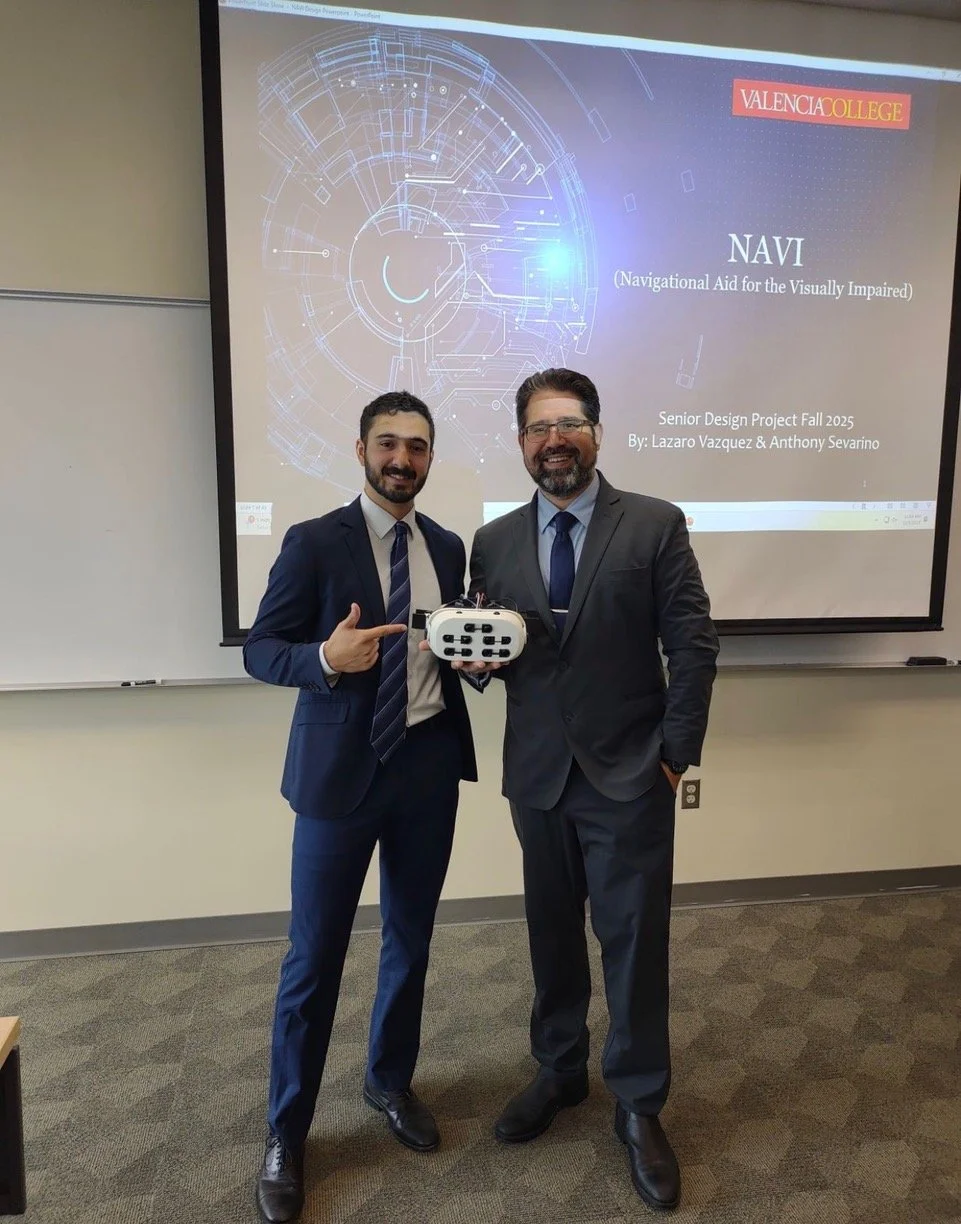
Valencia College engineering students Anthony Sevarino (left) and Lazaro Vazquez (right)
Nearly 253 million people across the world live with visual impairments, and unfortunately, many of these individuals still rely on centuries-old methods, like guide dogs, walking canes and human assistance, to navigate through their daily lives.
Two Florida engineering students are working to change that. Valencia College engineering students Lazaro Vazquez and Anthony Sevarino are combining the knowledge gained during their time on the Orlando campus with Vazquez’s personal experiences to complete a senior project that improves mobility and increases independence for those with visual disabilities.
Vazquez, who was born with a genetic eye disease, and Sevarino developed groundbreaking assistive technology called the Navigational Aid for the Visually Impaired, or NAVI. Inspired by the concept of a virtual reality (VR) headset, the duo designed a wearable navigation aid that utilizes infrared sensors to detect surroundings and haptic motors to generate vibrations to warn users of potential obstacles or dangers in their path.
Designing the NAVI
The NAVI utilizes pulse width modulation (PWM) that sends a vibration that intensifies as the user gets closer to an object. The system operates in a 360-degree field, providing the haptic response or vibration in the direction of an object, allowing wearers to better visualize the space around them.
The pair used survey data from the Lighthouse of Central Florida, an Orlando nonprofit dedicated to empowering people with vision loss, to help guide their design and implement components that visually impaired persons would find useful. They also wanted to design a product that leveraged a relatively inexpensive technology to keep things affordable for potential users.
“Our budget was very honed down to making sure that we can provide a prototype model that was able to meet the needs of the blind compared to the technologies that are already out there, but at a fraction of the cost,” Vazquez said.
Most navigational products on the market today, including smart canes, are unaffordable for many – some in excess of $3,000 – or require a costly monthly subscription. Other products are more complementary in nature and rely on smartphones or audio cues.
Vazquez and Sevarino were able to produce a working prototype of a more self-contained unit at a cost of $545.24 and estimate a complete device using one set of required components could be slashed to less than $500.
The pair 3D-printed all of the unit’s components using Polylactic Acid (PLA) – with the exception of the head strap and electronics – settling on the common filament after testing several others. A bit of polyurethane rubber was used to make the headset comfortable and moisture-wicking.
Meeting Challenges with Precision
During the project, Vazquez and Sevarino had to learn how to disassemble and clean a 3D printer, hand-file parts to fit precisely and compile a bill of materials. The pair had already sorted through project ideas in an earlier senior design proposal class, but the testing phase led to some of the more impactful and hands-on learning from the project.
“It really is about getting a base foundation on that proposal, but then testing it, and then having to make those necessary changes on the fly,” Vazquez said. “I had to redo the power budget two times based on just the battery, based on the IR sensors, as well as the other electrical components that we used, so testing and troubleshooting was a big thing as well.”
The final NAVI unit weighs less than 2.5 pounds and holds a charge for more than three continuous hours, both of which were established as system requirements from the onset. It also operates within the rated thermal limits under ambient conditions, ensuring that surface contact with the user does not cause discomfort or injury.
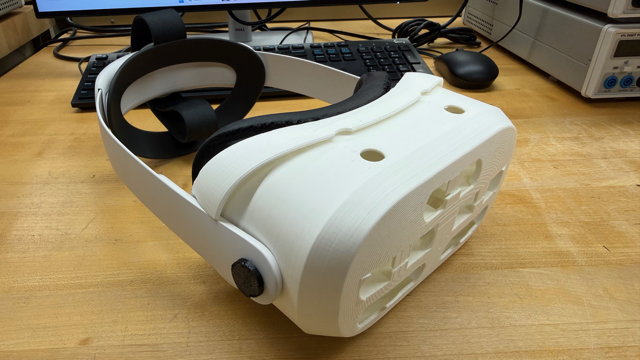
The final NAVI unit weighs less than 2.5 pounds and holds a charge for more than 3 continuous hours.
Valencia’s course schedule requires students to complete a proposal course before the design course. During this time, the team mulled two other ideas, including a LiDAR (Light Detection And Ranging)-based parking assistant system and a LiDAR-based spatial mapping module, ultimately settling on the NAVI.
“You come in with five to seven proposals and within a very short amount of time, we speak with our advisor and they start to weed out what we want to do,” said Vazquez, who will soon graduate from Valencia with an electrical engineering degree. “They look at those ideas and say, ‘OK, what is conceptually possible, but also challenging for the students?’ They really challenge us to justify our proposals as well as what we want to do.”
Vazquez and Sevarino met that challenge, turning their senior design project into a tangible device that can help countless individuals navigate their daily lives.
"This was a passion project, and also a project that we really feel,” Vazquez said. “Even if we were not to develop this in the future, it is something that we wanted to cater to support people that have accessibility needs.”