
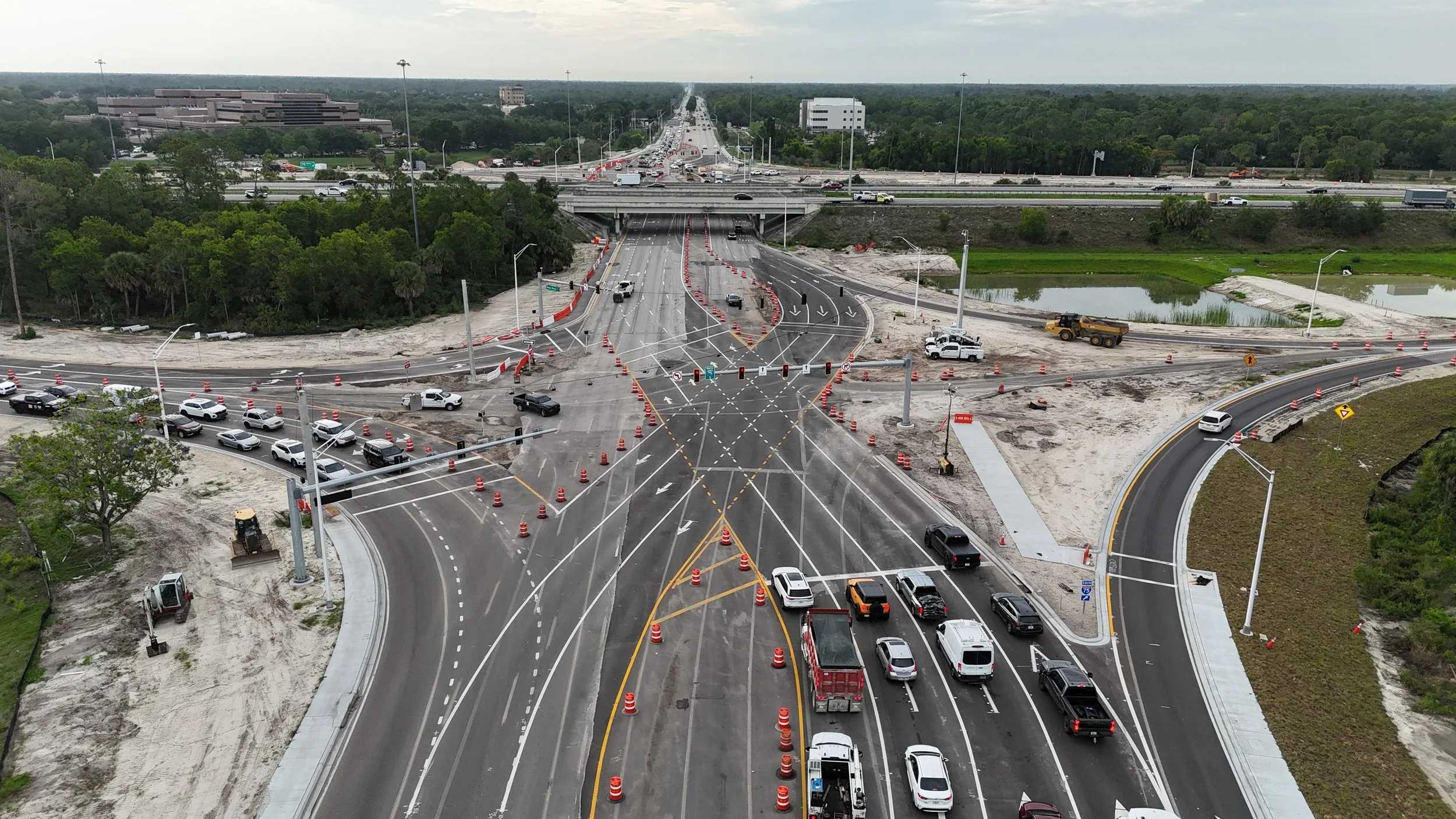
In Naples, the new diverging diamond interchange (DDI) will accommodate the over 90,000 vehicles a day traveling I-75 and the 70,000 vehicles a day traveling Pine Ridge near the interchange area. Photo Credit: FDOT
In early 2023, Governor Ron DeSantis launched the Moving Florida Forward Infrastructure Initiative, directing the Florida Department of Transportation (FDOT) to expedite construction of 20 critical road projects across the state, from the Panhandle to South Florida. The initiative invested $7 billion, including $4 billion in general tax revenue, on top of FDOT’s existing Five-Year Work Program.
“This proposal will break through bureaucracy that often slows down infrastructure projects and allow FDOT to target projects that will ease congestion across the state," DeSantis said on Jan. 30, 2023, during a visit to the central Florida community of Auburndale. “Expediting these projects will bring them to completion more than a decade ahead of schedule.”
“Governor DeSantis’ Moving Florida Forward proposal is truly historic, and the projects included will help relieve congestion while also focusing on safety, resiliency, the supply chain, and economic growth,” said FDOT Secretary Jared W. Perdue, P.E. “These are important for Floridians’ quality of life and to ensure we maintain a strong transportation system to keep Florida moving forward.”
This bold initiative is already achieving results. With a combination of unprecedented funding and a new way of doing business, the strategic plan to improve connectivity, enhance safety and reduce congestion on the state’s roadways is boosting economic growth and enhancing the quality of life for Floridians in record time.
FDOT’s Innovation in Action
This historic investment of funding was just one component of the initiative. In developing plans to deliver Moving Florida Forward projects quickly and efficiently, FDOT introduced a groundbreaking approach to contracting, Modified Phased Design-Build (MPDB), to reduce the cost and time to construction.
This first-in-the-nation construction delivery method enables FDOT to select multiple design and construction teams for a single project based on their expertise and experience to collaboratively develop a cost-effective approach. Firms then compete based on innovation, collaboration and a Project Guaranteed Max Price (PGMP). This process allows construction to begin earlier than with traditional delivery methods, which provides benefits to Floridians years ahead of traditional schedules while maintaining quality and safety standards.
The key objective of the new model is to achieve cost certainty from day one and mitigate common risks from traditional adjusted score design-build procurements. Because of its success at reducing costs and time from construction projects, this framework has become a model throughout Florida and is being explored by other states.
Reducing Congestion along the Bustling I-4 Corridor
Many Floridians and visitors alike have experienced the frustration of driving – and often sitting – on I-4 in Orlando, one of the nation’s busiest and most congested highway corridors.
FDOT incorporated five Moving Florida projects on the I-4 corridor into one cohesive unit called Moving I-4 Forward. One of the first steps FDOT took was to deliver six miles of congestion relief lanes in April 2025 through one of the busiest sections of I-4 eight months ahead of an already accelerated schedule. The project added an additional lane in each direction from U.S. 27 in Polk County to World Drive in Osceola County and reduced travel times by approximately 50 percent after opening.
The congestion relief lanes served as a pilot for Florida's MPDB program and demonstrated how alternative delivery methods can safely accelerate construction while maintaining accountability, quality, and performance standards.
Transforming Florida, One Project at a Time
A little farther southwest on I-4, FDOT kicked off construction of the I-4 at State Road 33 Interchange Improvement and Wildlife Crossings project in Polk County in 2025, which includes interchange and capacity improvements as well as two wildlife crossings. The interchange at S.R.33 is being reconstructed into a Rural Diamond Interchange, while a few miles away, the project is creating the state’s first overpass that wildlife can use for safe passage over traffic. The entire project should be completed by 2029, with the wildlife crossings expected to wrap up in the coming months.
At I-95 and U.S. 1 near Ormond Beach, an antiquated interchange dating back to the 1960s was already accelerated 10 to 15 years ahead of schedule, but was accelerated by an additional year thanks to MPDB. The modern interchange will provide for operational improvements and additional capacity on U.S. 1 by widening a one-mile segment to six lanes.
In the Central Florida area, FDOT broke ground on several Moving Florida Forward projects in 2025. That scope includes 30 miles of new I-75 auxiliary lanes in Marion County, bringing relief to 114,000 daily drivers on a timeline 10 to 15 years ahead of the previous schedule.
The I-275 Express project broke ground in August of 2025 in Pinellas County. The project will widen I-275, add new express lanes and, when complete, is expected to reduce travel delays by up to 85 percent. This project is one piece of a broader effort to relieve congestion across the region as part of a multi-phased approach, including linking with other major congestion relief projects in the area, like the newly completed Gateway Expressway and Howard Frankland Bridge.
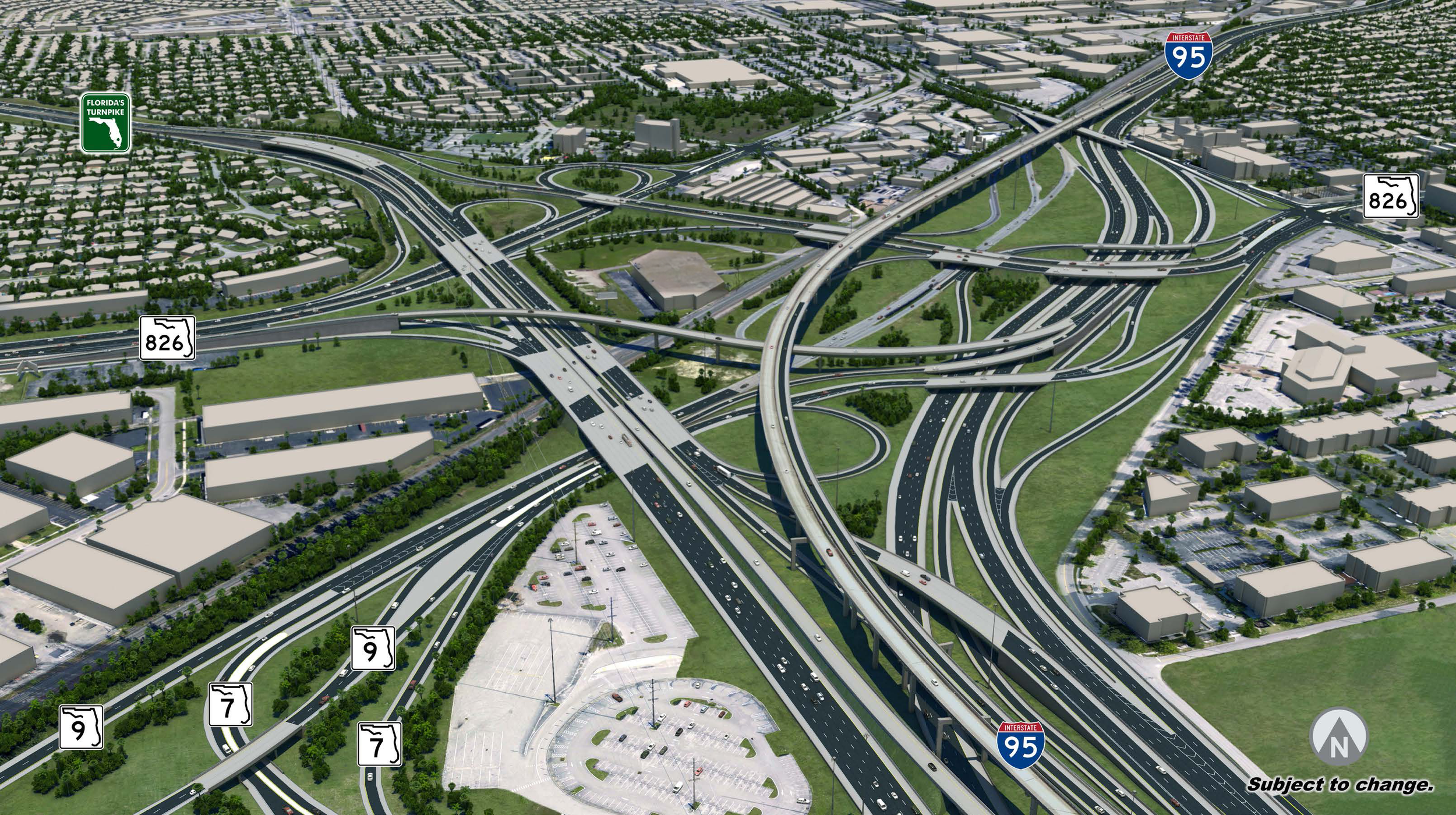
The Golden Glades Interchange in Dade County is due to be completed 2031, one year ahead of schedule. Image Credit: FDOT
Two other notable projects address traffic in busy South Florida. One project, the Golden Glades Interchange project in Miami-Dade, is the largest design-bid-build project in Florida’s history. Currently, traffic is already traveling on 17 of the 34 new bridges being built as part of the project. The entire project is tracking an additional year ahead of schedule, with a completion date in 2031.
FDOT has also begun construction activities on the SW 10th Street Connector project in Broward County. This comprehensive project will complete the missing link between the Sawgrass Expressway, Florida’s Turnpike, and I-95 and is expected to save commuters 2.5 days per year in travel time.
DeSantis' vision for accelerating congestion relief, coupled with the willingness of contractors, designers, and transportation leaders to embrace new ways of doing business, helped raise the bar for project delivery in Florida. FDOT had a goal of getting all twenty Moving Florida Forward projects underway in four years, and has achieved that goal.
The success of the Moving Florida Forward Infrastructure Initiative created a model that is influencing major projects across the state and helping deliver transportation benefits to Floridians faster than ever before.