
Mapping Things Out: FIU Student Project Enhances Reconstruction Technology
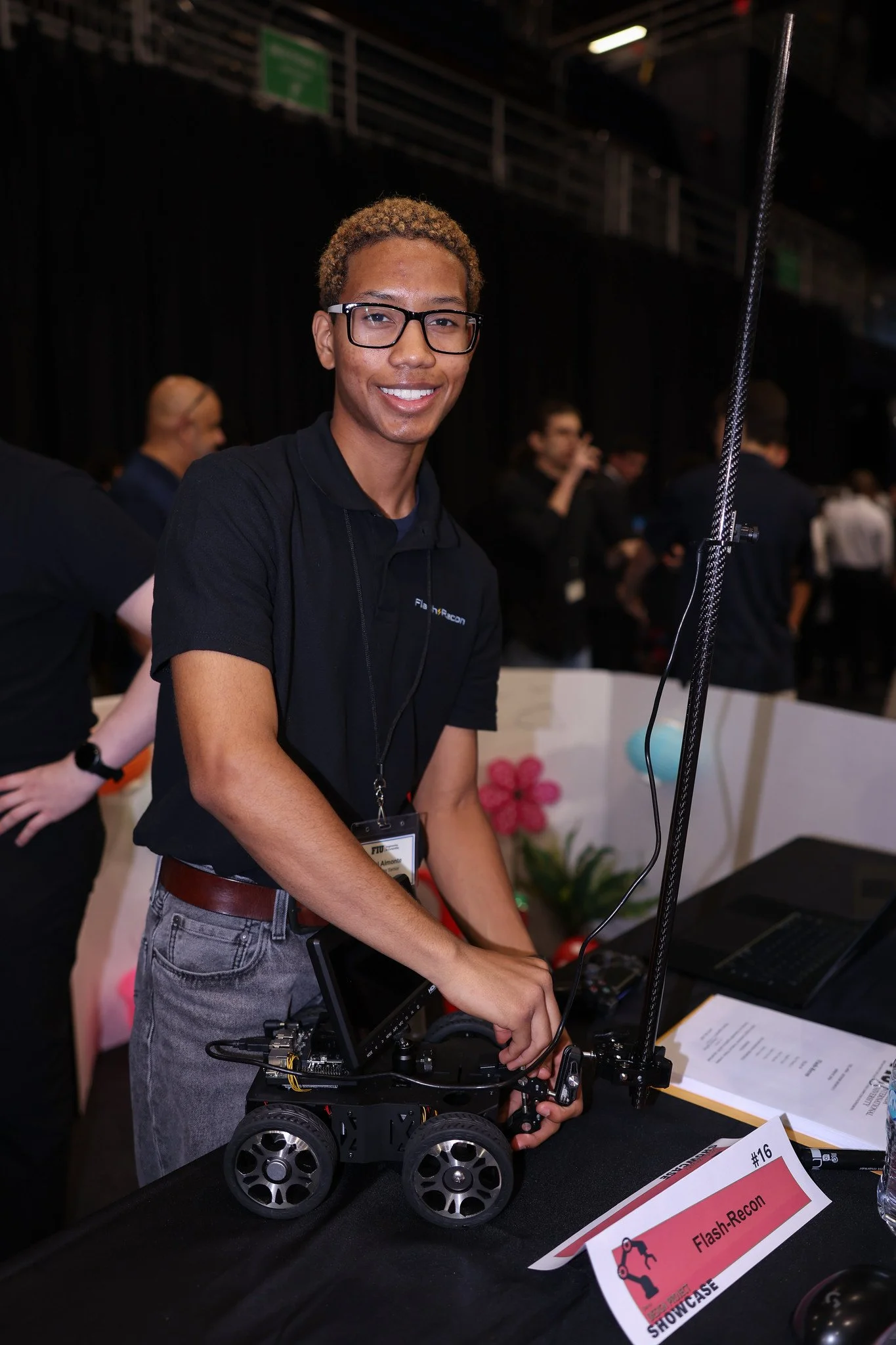
Abiel Almonte
Even before becoming a licensed engineer, Abiel Almonte is already making his mark in the industry.
The Florida International University computer engineering student completed his senior design project that filled a gap in existing 3D reconstruction technology of static spaces. Known as Flash-Recon, Almonte's project runs simultaneous localization and mapping (SLAM) and Gaussian Splatting, a technique that converts 2D media into detailed, interactive 3D scenes, to produce a spatial rendering from a single webcam input.
"Initially, it was just a passion for visualization," Almonte said. "I'm really into machine learning and also high-performance computing, and I wanted to capture some video feed and reconstruct it into a 3D world."
Almonte's work reimagines the existing DROID-SLAM process – a highly accurate, deep learning-based visual SLAM framework first created by members of Princeton University – from the ground up.
His method relies on Lie group operations, a complex branch of mathematics based on space and transformations. It also utilizes factor graphs, a class of graphical models with variables and factors, and bundle adjustment, a computer vision and photogrammetry process that refines and optimizes points of the scene it creates.
The project hinged on four main goals: a singular camera, low computing power, real-time computing and producing photorealistic results.
"I asked, 'How can I capture some video feed like a live stream and then reconstruct that into a 3D world?'" Almonte said. "When I was looking into how to actually implement my ideas, I noticed nearly all existing processes didn't do what I was thinking."
Almonte wrote his own units of code – known as Compute Unified Device Architecture (CUDA) kernels – that are similar to procedures or functions that target central processing units (CPUs). One of the more challenging technical aspects of the project was ensuring these kernels were analytically correct while accelerating foundational linear algebra operations.
Almonte mounted a camera on a remote-controlled robot, which captured the frames and sent them to a desktop to run the computations and project the live rendering. Wiring the robot was one of the more complicated parts for the computer engineer.
The system's fast odometry allows Gaussian Splatting to update the stream asynchronously, essentially allowing the system to render a visual without lagging or freezing.
"A lot of the time, (existing options) were just so computationally heavy that it just runs offline – after the fact – or they would require expensive or other equipment like LIDAR or depth camera," Almonte said. "It wasn't accessible to everybody."
A comparison shows the power of Almonte's process. His system runs on a single RTX 4070 GPU, while other models use more expensive, less practical or multiple GPUs to work. Almonte’s system utilizes a lower amount of Video Random Access Memory (VRAM), a specialized type of memory that GPUs use dedicated to visual processing, than existing models.
In addition, his custom CUDA kernel brings the per-call cost from 4.98 milliseconds to 1.34 milliseconds using Shur complement decomposition.
The downstream applications for Almonte's work include simulation for robotics or use in future travel; currently, Tesla uses Gaussian Splatting for its autonomous vehicles.
Almonte's project originated before his senior design course. He joined a research lab that introduced him to programming and forged a relationship with the lab's principal investigator to begin implementing the project early due to its complexity.
"It's almost like a language that you end up learning, and it's very transferable in the way you think through problems," said Almonte, whose experience in the lab led him to an internship with Nvidia. "I would say it definitely fed my interest and gave me things to be interested in because it was kind of like an AI lab."
Almonte’s senior design project has inspired him to pursue spatial intelligence, computer modeling and programming in his future career.
"I think this was the genesis or the beginning of my passion for this efficient on-device computer vision," Almonte said. "I want to tackle these more modern approaches to reconstruction or to just spatial intelligence in general. I have a North Star that feels true to me."