
Back to School: Florida Engineering Schools Rise to the Challenge of a Changing Industry
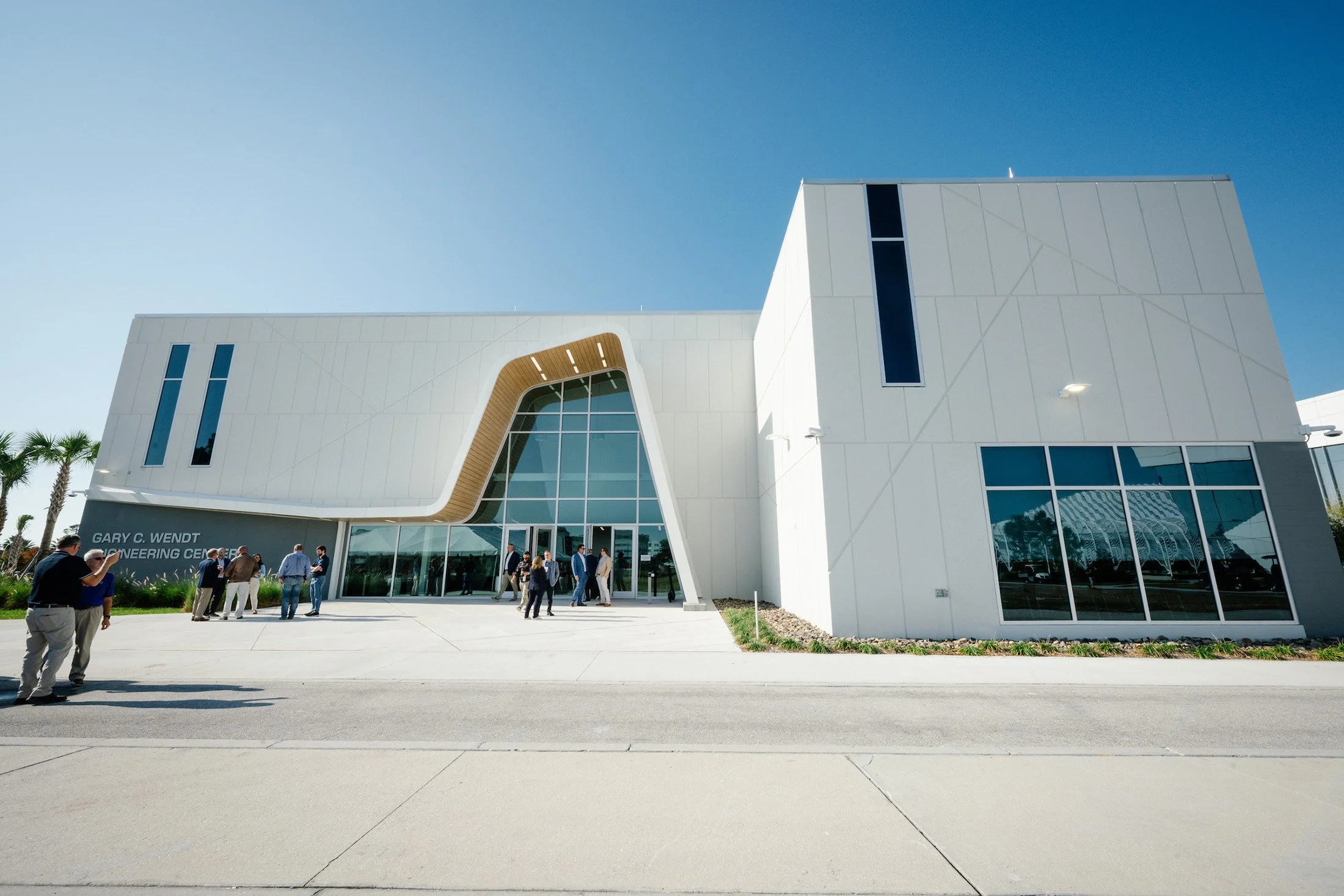
Florida Polytechnic University opened its new 40,000-square-foot Gary C. Wendt Engineering Center in November 2025.
Florida’s 12 ABET-accredited engineering schools are reimagining engineering degree programs to keep up with emerging technologies and meet the ever evolving needs of the workforce. And rising enrollment in engineering programs shows their strategies are working.
New Curriculum Coming to the FAMU-FSU College of Engineering
In Tallahassee, the National Science Foundation awarded FAMU-FSU College of Engineering $10 million in grants to develop a curriculum for Quantum Information Science and Engineering (QISE). The Graduate Certificate in Quantum Science & Technology program will debut in Spring 2027, reflecting a collaborative effort between the FAMU-FSU College of Engineering and the Florida State University College of Arts and Sciences.
“The most important challenges in emerging technologies cannot be solved within the boundaries of a single discipline,” said Suvranu De, Dean of the FAMU-FSU College of Engineering. “[This certificate] is exactly the kind of interdisciplinary collaboration needed to tackle fundamental scientific challenges and develop the quantum technologies of tomorrow.”
Florida Polytechnic University Adds Engineering Degrees
Florida Polytechnic University in Lakeland, the state’s only public university dedicated exclusively to science, technology, engineering, and math (STEM), introduced two new bachelor’s degrees this fall – one in aerospace engineering and the other biomedical sciences. tapping 32 new expert educators to deliver the new programs. Florida Poly’s new offerings follow the introduction of two Masters of Science degrees - one in Mechanical Engineering and another in Electrical Engineering – in 2024.
Students have responded. In just two years, total enrollment at Florida Poly has skyrocketed by 35 percent to more than 2,300.
“Our academic growth is driven by a clear understanding of where Florida’s workforce is headed and how Florida Poly can help meet those needs,” said Dr. Brad Thiessen, the university’s provost. “By developing more programs in emerging fields and bringing outstanding faculty into our classrooms and labs, we are creating new opportunities for students while strengthening the rigorous, hands-on academic experience that is central to a Florida Poly education.”
Interest Grows for Combined Degree Programs the University of Florida
New programs at the University of Florida (UF) Herbert Wertheim College of Engineering have attracted more students, with enrollment now at more than 11,000 students.
“We've seen the enrollment numbers in engineering grow in general, which is exciting,” said Sarah Furtney, Director of Experiential Learning at the College. “There continues to be the need and demand for engineering, and we’re responding to what we're seeing out in industry and also in research.”
UF also recently launched a new B.S. in Industrialized Construction Engineering and master's degrees in artificial intelligence systems and applied data science. There’s also growing interest in the school’s combined degree programs, which give students a path to complete a bachelor’s degree and master’s degree in five years with specific, trending emphases in mind.
“Four-plus-one is growing quite a bit,” said Idalis Villanueva Alarcón, professor and chair of the Herbert Wertheim College of Engineering’s Department of Engineering Education. “You could be a biomedical engineering student, for example, who is interested in AI systems, and you can get both, right? An extra 12 credits will get you that master's in the AI systems, which is a nice incentive for our students as well.”
The College is continuing the rollout of its Artificial Intelligence Academic Initiative (AI2) Center. With a goal to train an AI-ready workforce, AI2 is identifying opportunities for faculty and students to engage with AI while coordinating academic programs and future certificates in the topic.
UF has also expanded its elective course offerings to address emerging topics. The college is also seeing an increase in certificate completion, including certificates in innovation, project management and business.
“Students use the electives as the opportunity to either have more breadth or to actually have depth with a particular specialty they're interested in,” said Furtney.
An Eye for AI at University of Central Florida
The University of Central Florida is also leaning in on research and the leading edge of AI, adding 25 faculty members to its Institute of Artificial Intelligence hosted in the College of Engineering and Computer Science. The Institute’s faculty have a dual focus on education and research in areas like AI theory and applications for robotics and machine learning.
“AI has revolutionized our lives and has revolutionized the education and research that is happening across the nation,” said UCF College of Engineering and Computer Science Dean Michael Georgiopoulos. “These faculty are going to make a difference. This is an area that UCF has focused very aggressively. They have done very well, and they are pushing forward with particular investments in this particular area.”
University of West Florida Combines Academic Integrity with Adaptability
The University of West Florida adopted the standard 120-credit hour schedule for its Bachelor’s of Science in Computer Engineering (BSCE), Electrical Engineering (BSEE) and Mechanical Engineering (BSME) programs, which previously required 127 and 128 hours, respectively.
The updates ensure the degree programs uphold ABET accreditation standards and Fundamentals of Engineering exam requirements while ensuring academic programs in areas of strategic importance and meeting specific workforce needs.
Rigorous, Relevant Curriculum at the University of South Florida
The University of South Florida is transitioning its existing Bachelor’s of Science in Computer Engineering into a new B.S. in Computer Science and Engineering. USF removed courses including Calculus III and Differential Equations and added requirements in Secure Coding, Software Engineering and an elective course in theory. The curriculum retains many of its computing courses, including Computer Organization, Logic Design and Operation Systems.
USF has also introduced an M.S. in Computer Engineering Systems, offering thesis or non-thesis track options. The program allows students to pick from six focus areas, including artificial intelligence (AI), machine learning (ML) and data systems, quantum computing and emerging technologies, and computer and data security.