
Project of the Year - Sanibel Causeway
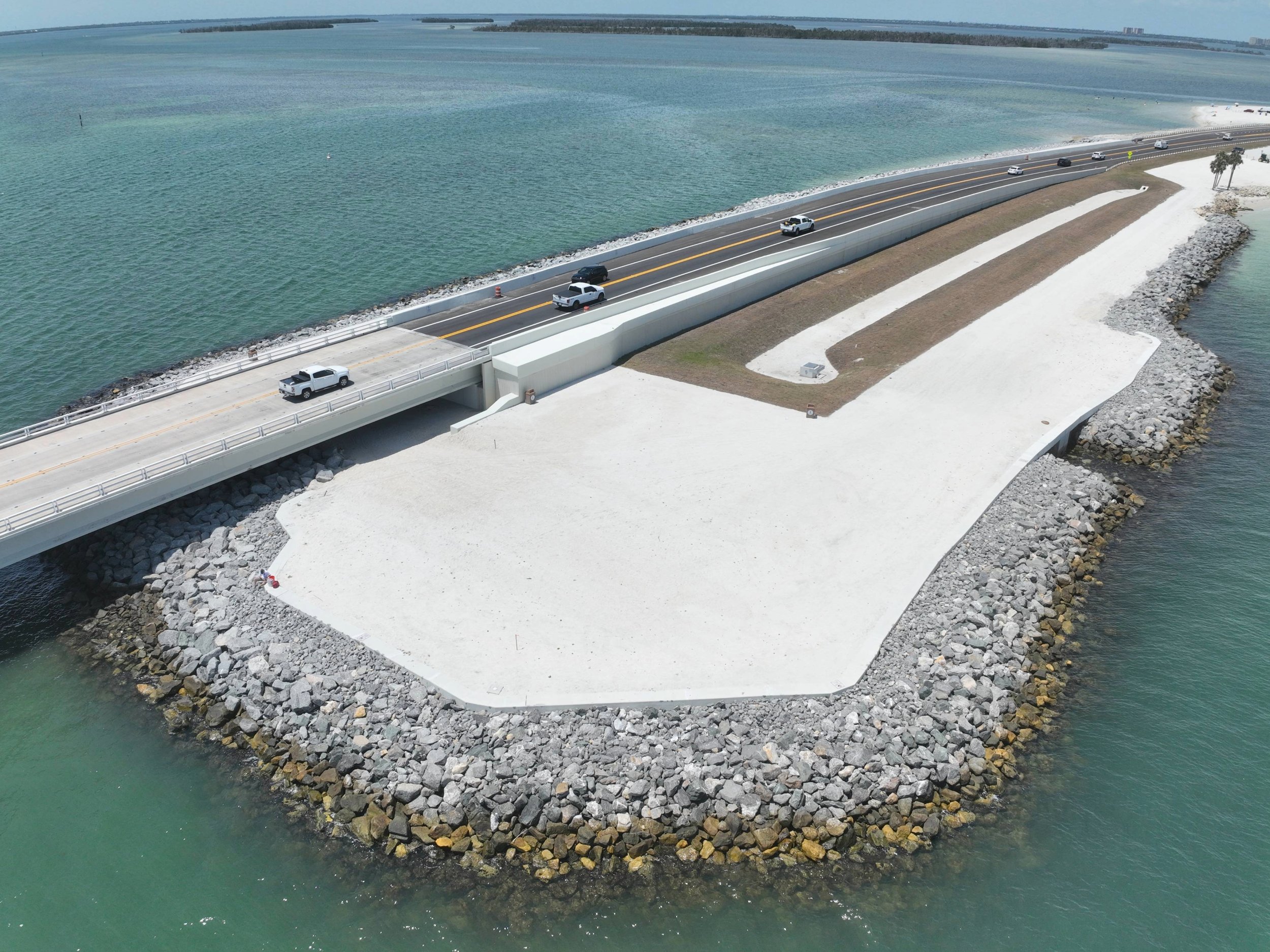
The completed Sanibel Causeway. Photo by Superior Construction.
When Category Four Hurricane Ian barreled through Florida’s Gulf Coast in September 2022, the Sanibel Causeway suffered catastrophic damage. The storm, which took more than 150 lives and caused $112 billion in damage, washed away portions of the Causeway and rendered it unusable.
Without access to the Sanibel Causeway, a three-mile-long stretch of islands and bridges that serves as a critical link between Sanibel and Captiva Islands and mainland Florida, many island residents were left stranded in the storm’s wake.
Rapid Response to Long-Term Solutions
The Causeway’s destruction not only created a harrowing situation for residents, but it also presented monumental logistical challenges for the Joint Venture team of Superior Construction and The de Moya Group. Selected by the Florida Department of Transportation (FDOT) for its first phased design-build contract that included both emergency repairs and permanent reconstruction, the Joint Venture team arrived in Sanibel within just 24 hours of Ian’s landfall.
“It was a disaster zone, to say the least,” said Toby Mazzoni, area manager for Superior Construction. “When you show up, or you think of going to a construction project, all the things that you have available to you to build a job [were] no longer available.”
Workers were housed in mobile trailers at the local airport and all meals were grilled on-site. The crew relied on boat transportation to travel to and from the island and linked to first responder networks to communicate. More than 100 crews worked around the clock and completed the necessary emergency repairs to restore utility vehicle access in seven days and resident access to the Causeway in just 15 days. In total, the crew finished 36,000 workforce hours within this timeframe.
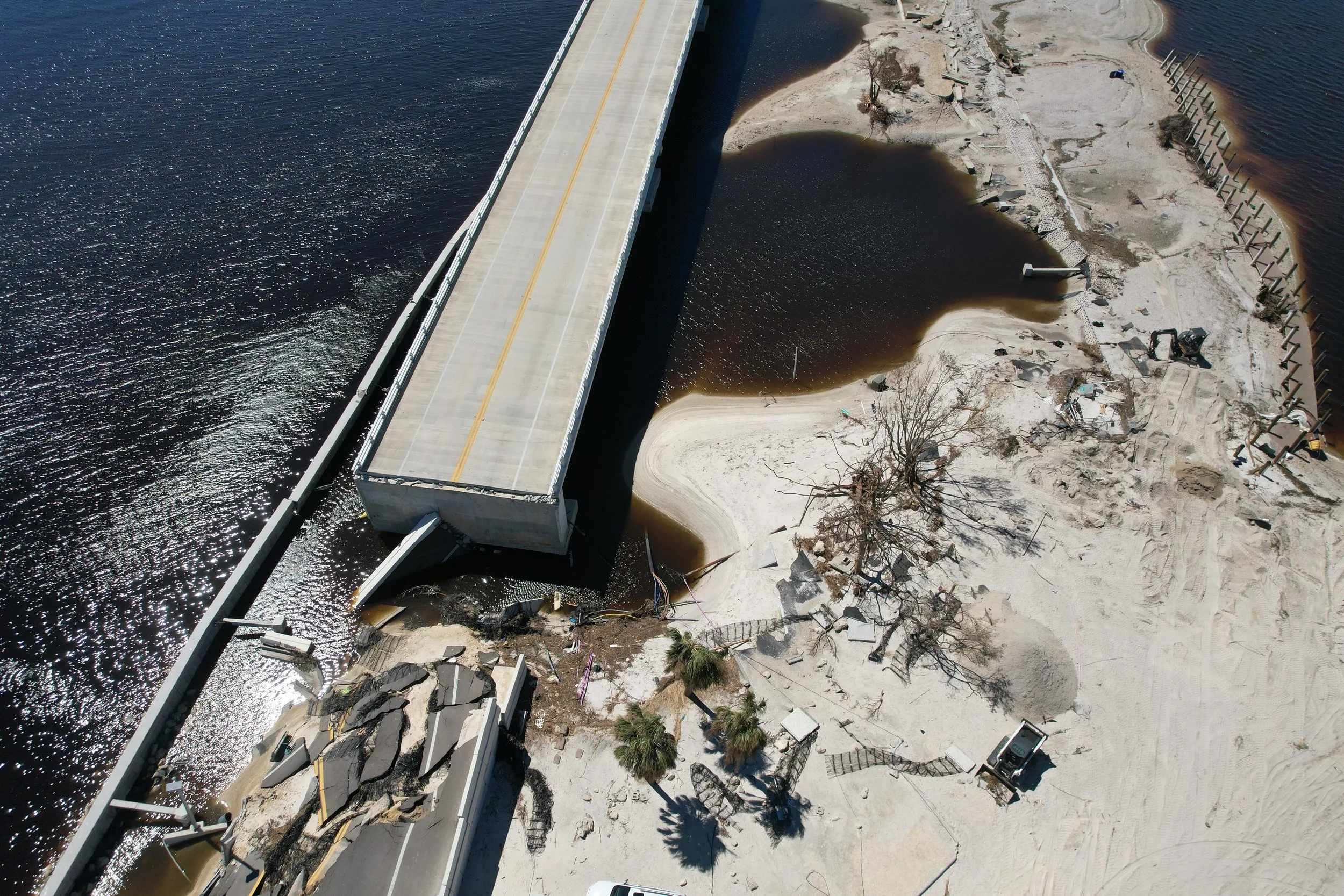
The Sanibel Causeway suffered significant damage when Hurricane Ian struck the area in 2022. Photo by Superior Construction.
“Things that typically aren’t a challenge on a job were some of our biggest obstacles,” said Superior Construction Central Florida Division Manager Ryan Hamrick, who led the Sanibel emergency repairs joint-venture team. “Accessing the site, securing crew housing, providing meals, delivering equipment and fuel to the job site, sourcing electricity — all of it required time and careful coordination. But our teams were ultimately successful because every single person on the job site was laser-focused on helping the community reestablish connection to the mainland.”
The emergency repairs required 70 pieces of heavy equipment, four barges, five boats, two dredges and seven cranes. Materials included 8,200 loads of fill dirt, 2,400 loads of rocks and 4,000 tons of asphalt.
An additional challenge for the team during this phase of the project was to ensure that they could incorporate as many of the emergency repairs into the final design as possible, Mazzoni said.
Resiliency Up to the Test
After the emergency repairs, the Joint Venture team worked to design and build resilient causeway islands, roadway and bridge approaches to withstand future storms. The causeway, completed in May 2025, was tested in 2024 when Hurricanes Milton, Debby and Helene hit Florida during the construction process.
In order to protect the completed sections of the Causeway as these hurricanes passed through, the Joint Venture team built five seawalls and strategically placed 127,996 tons of high-quality armor stone materials from Alabama and Georgia quarries to improve resilience. While unfinished sections of the Causeway were damaged during the storms, completed sections remained intact.
“When the water came up, it went over all the walls, and then when the water went back, we had little to no damage in the areas that were complete,” Mazzoni said. “So there was some pretty good validation as to whether the engineering is going to work or not work.”
Engineers relied on steel sheet pile wall systems and 19,750 total linear feet of concrete caps for the Causeway’s final design. Because much of the damage caused by Hurricane Ian was scour-related, the team drove the walls deep enough below ground to prevent this occurrence in the future.
“So, if you get that water surge again, the idea is that the scour will never happen to cause the walls to fail,” Mazzoni said.
Designers also elevated the roadway by two feet on the island portions of the Causeway for protection from both scour and storm surges. The concrete seawall caps were also raised from an elevation of five feet to eight feet, and additional scour protection was provided through a marine mattress of basketball- and softball-sized stones beneath the sand.
The seawalls were upgraded with more resilient concrete and fiber reinforced polymer (FRP) reinforcement to withstand the saltwater environment. The drainage system was updated to hold increased water capacity and allow water to escape quickly.
Ian’s arrival set a new design standard for engineers creating structures to withstand 100- and 200-year storms, Mazzoni said, as the storm data for Ian exceeded prior calculations.
The Sanibel Causeway is now positioned to survive similar storms in the future.