
Florida Engineers Protecting Water Quality Across the Sunshine State
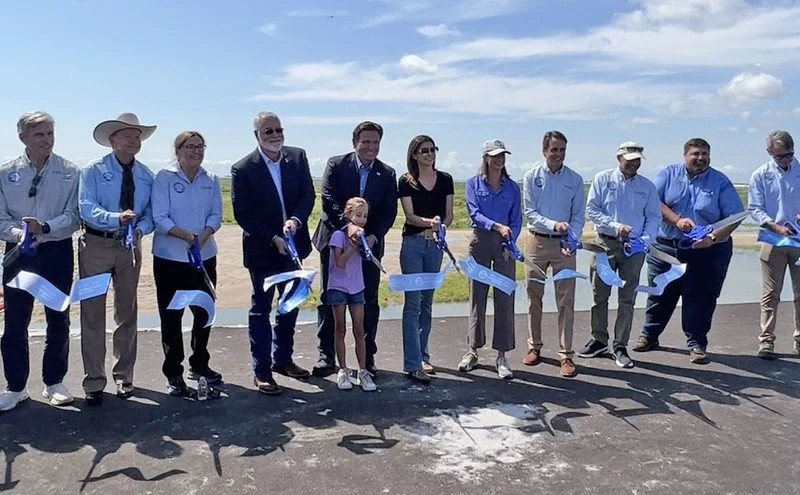
Florida Gov. Ron DeSantis and other dignitaries hold a ribbon cutting for the C-43 West Basin Storage Reservoir, an engineering project that reduces the volume of lake discharges in wet seasons and provided freshwater flow to the estuary in dry ones. Photo provided by SFWMD.
Engineers play an integral role in restoring and protecting water quality in Florida. Their technical work, from planning and design to water quality monitoring to the development of pollution reduction targets, serve as the basis for strategies to increase protection for this valued resource.
One example of their contributions are the recent updates to the Basin Management Action Plans (BMAPs) which provide a framework with a comprehensive set of solutions to reduce pollution in the state’s water bodies.
The updated BMAPs reflect renewed efforts to protect the state’s water resources. BMAPs were developed in collaboration with local governments and agencies, setting clear pollution reduction targets, and each identifies strategies and projects that promote long-term health for waterbodies.
BMAP development and implementation rely on the technical work of engineers across the state, from planning and design to the monitoring of waterways and nutrient pollution levels.
New BMAP Updates
FDEP adopted 28 updated BMAPs in July, each providing a framework for reducing nutrient pollution in rivers, lakes, springs and other waterways. It also implemented a series of five-year milestone reports for BMAPs that didn’t already have them in place. The department hosted more than 60 public meetings and 100 one-on-one meetings with regulated entities to ensure stakeholder engagement.
“These BMAPs reflect DEP’s commitment to making data-driven decisions and maintaining transparency in our efforts to restore Florida’s water resources,” said Florida Chief Science Officer Dr. Mark Rains. “By incorporating rigorous scientific analysis and continuous monitoring, we are ensuring that our restoration strategies are both effective and adaptable to emerging challenges.”
Engineers play a large role in the strategy of these plans. Through evaluating watershed conditions, quantifying loads and designing projects, they use their knowledge and skill to promote future change. On the other side of the process, engineers use data and analysis to determine whether the projects, plans and initiatives in action are actually resulting in reductions.
Engineering projects are central to the success of each BMAP. In the Caloosahatchee River and Estuary BMAP, the South Florida Water Management District (SFWMD) completed a hydraulic enhancement of Lake Hicpochee. Headed by Burns & McDonnell, the project delivers excess stormwater runoff from the C-19 canal to the north end of the lake while rehydrating a portion of the lake bed to promote habitat restoration storage.
Last summer, SFWMD completed its C-43 West Basin Storage Reservoir, another engineering project that reduced the volume of lake discharges in wet seasons and provided freshwater flow to the estuary in dry ones. J-Tech, an alliance between Jacobs Engineering and Tetra Tech, performed site management on this project, while Carollo Engineers and Stanley Consultants led design.
Additionally, Hendry County is taking the lead on the North LaBelle Water Quality Project, centered on treating stormwater prior to its discharge in the Roy Brown Canal, which flows into the Caloosahatchee River.
Each BMAP includes restoration activities such as fertilizer ordinances, waterway walks, educational projects and best practices in addition to its engineering projects. Every plan is designed to be implemented in five-year phases over a 20-year timeframe.
The state also laid out best practices for non-governmental organizations including golf courses and agricultural producers and landowners. Golf courses residing in a BMAP zone are required to introduce management strategies to mitigate their nutrient loading and comply with the BMAP’s standards. Similarly, agricultural properties in BMAP zones must either conduct specific water quality monitoring activities or enroll in the Florida Department of Agriculture and Consumer Services (FDACS)’s Best Management Practices (BMP) Program.
Differing Water Standards
Each BMAP identifies a Total Maximum Daily Load (TMDL), a calculation of the maximum amount of a particular pollutant allowed to enter a body of water so that the waterbody will meet and continue to meet water quality standards, establishing these limits for every pollutant of concern for a particular waterway.
The state’s water quality standards differ by distinct classes of waterways. Class I waterways represent potable water supplies; Class II is designated for shellfish propagation or harvesting. Class III waters are designated for fish consumption, recreation and maintenance of fish/wildlife populations, while Class IV waterways represent agricultural water supplies. No current water sources are currently designated as Class V, which are for navigation, utility or industrial use.
The Weeki Wachee Springs BMAP, for example, uses nitrite as a core parameter that will be tracked to determine progress towards meeting TMDL. For some BMAPs, orthophosphate, ammonia and/or fecal indicator bacteria are used as core parameters, while supplemental indicators, including pH, temperature, total suspended solids (TSS) levels and/or dissolved oxygen are used to build information about water quality but are not direct measurements of impairment.
In addition to TMDLs, FDEP also tracks the direct biological responses – including linear vegetation surveys and recording the amount of Chlorophyll a – to see how water quality improvement or decline is affecting wildlife.
Continuous Review and Improvement
On top of updating the BMAPs every five years, the state completes five-year reviews of BMAPs and their plans. These reviews provide updates on the status of implementation of certain aspects of the plan and make recommendations for future BMAP phases.
It’s been more than a quarter century since the Florida Legislature passed the Florida Watershed Restoration Act, providing a pathway to restore waterways through BMAPs. Though their existence is often seen through a lens of policy and fulfilling legislative expectations, the success – or failure – of BMAPs largely rests on the technical execution of engineers across the state who use their expertise to restore the resource across the state.
“For years, DEP has worked closely with stakeholders across Florida to assess water quality, establish pollution reduction goals and identify projects and strategies to achieve meaningful, measurable improvements,” said FDEP Secretary Alexis A. Lambert in a June release. “[The] adoption of these plans is a significant milestone made possible through input, collaboration and dedication.”