
Project of the Year: Brightline Florida’s East-West Connector
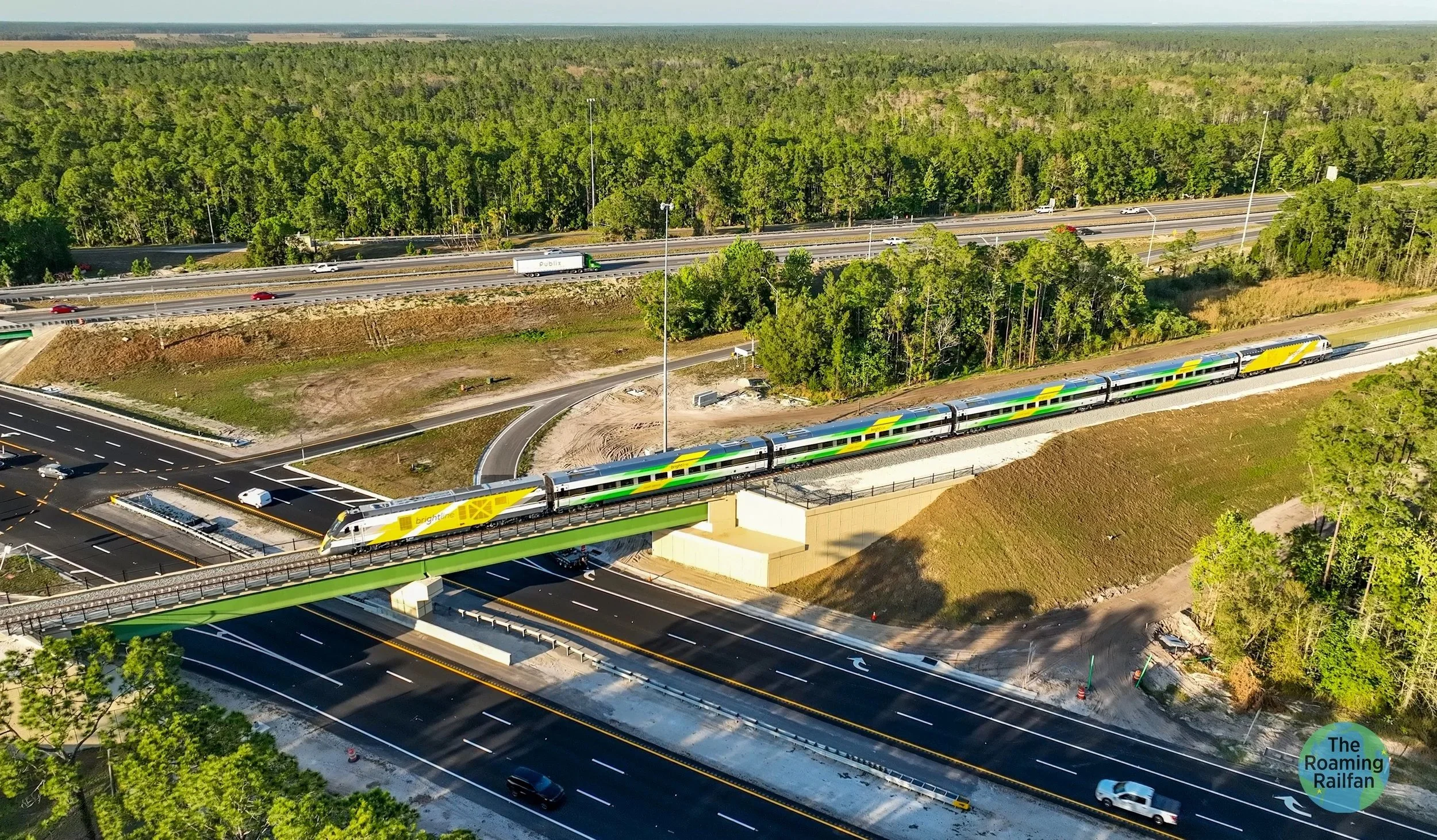
HNTB’s design for the East-West Connector included 32 new bridges. Photo courtesy of Brightline.
With a thriving tourism industry and a population that has exponentially grown since the onset of the COVID-19 pandemic, Florida’s transportation infrastructure has experienced unprecedented levels of congestion in recent years.
Brightline, a provider of modern, inner-city rail solutions, has sought to ease some of the burden on Florida’s roadways with its East-West Connector. The East-West Connector completes Brightline’s 235 miles of railway from Orlando to Miami, linking Cocoa to Orlando with the final 38 miles of track.
The complete route partially runs on existing Florida East Coast Railway tracks and was finished in 2023 under budget. Among its many awards and accolades, the East-West Connector, constructed in partnership with HNTB, earned the 2025 ACEC Florida Grand Conceptor Award. The award is presented to the year’s most outstanding engineering achievement in Florida.
“We are honored to have partnered with Brightline Florida on the East-West Connector project,” said George Gilhooley, HNTB’s East Florida office leader and senior vice president. “Brightline’s vision for a connected Florida has transformed the state. We are incredibly proud to have helped bring this project to life.”
HNTB’s design for the East-West Connector included 32 new bridges, grading, drainage, communications, signal layout and utility relocation. Building the track from Cocoa to Orlando presented numerous engineering challenges such as incorporating wildlife crossings, the complex infrastructure of the Orlando International Airport and a unique solution for the crossing at the Interstate 95 Interchange at State Road 528.
“We had to cross the highway, but a rail bridge is about twice the cost of a highway bridge,” Gilhooley said. “We temporarily moved 528 and put in a tunnel so that the train stayed at grade. Then we just reconstructed 528 over that tunnel and were able to essentially keep the train running at a much higher speed.”
The crossing at S.R. 528 represented the first use of the box-jacking method in North America under a highway system with live traffic. The method required large concrete boxes to be precast outside the roadway, and those boxes were ultimately pushed under S.R. 528 using hydraulic jacks. This solution reduced five separate bridges to a single 574-foot-long bridge over the south side of I-95 and saved Brightline $25 million and six months of construction time.
With the railway’s passage through environmentally sensitive land, the wildlife crossings that were included in the project catered to a diverse wildlife population from bears to deer. Engineers designed a shelving system under the rail bridge with elevations at the proper height above the waterline for species to cross.
Existing track from the Florida East Coast Railway was incorporated in the project, requiring engineers to develop solutions for upgrading the track to meet the demands of high-speed rail.
“There was a lot of work,” Gilhooley said. “We double tracked or triple tracked a lot of it out there to have the capacity to run passenger rail in addition to the freight rail that was on (the line) already, but it was also upgrading the tracks to a higher speed.”
Finally, HNTB engineers not only had to navigate the track through the Orlando International Airport’s complex infrastructure, but they also managed multiple relocations of fiber optic lines and other utilities during the construction process.
The resulting rail system linking Miami and Orlando operates 32 trains per day with 16 daily departures from Miami and Orlando. It has removed an estimated 3 million cars from Florida’s roadways annually, equating to 72 metric tons of CO2 emissions. Trains operate at speeds of 125 mph, with the potential to run at 150 mph as technology advances, and the full trip from Miami to Orlando takes approximately three hours and 25 minutes.
“The East-West Connector is an essential transportation link, providing sustainable, efficient travel from Miami to Orlando,” said John Hornbeck, HNTB’s project director for the East-West Connector. “We are thrilled to have a positive impact on the communities where we work and live.”