
Finishing Orlando’s Beltway: Wekiva Parkway Section 8 Completes Missing Link
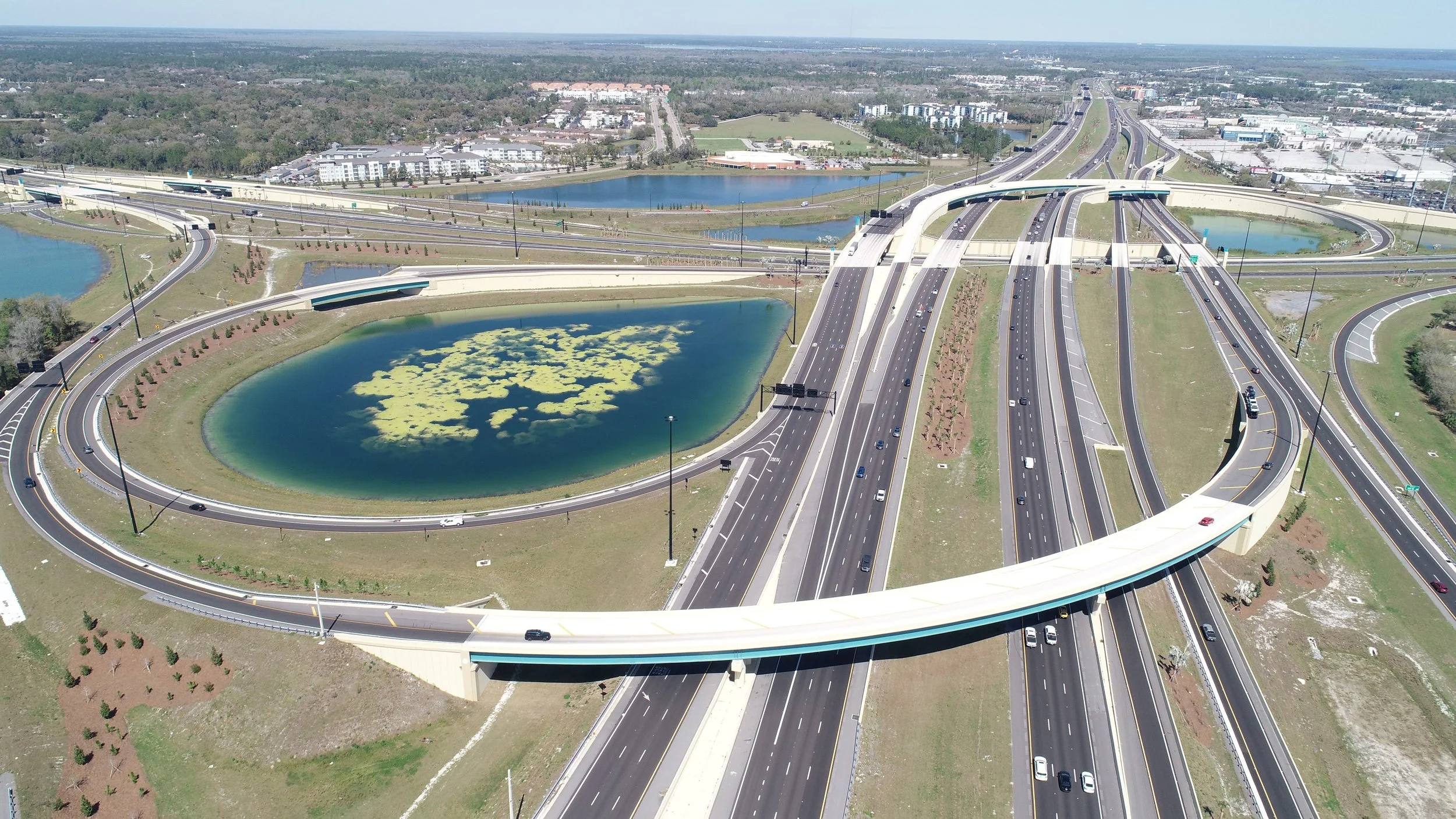
Wekiva Parkway Section 8 is the final segment of the 25-mile limited access toll facility for the Florida Department of Transportation (FDOT) and the Central Florida Expressway Authority (CFX) that ultimately connects Interstate 4, S.R. 417, and S.R. 429 with a new system-to-system interchange. Photo by DRMP
The long-anticipated beltway around Orlando finally has its missing link, and the completed project has a growing list of awards.
Wekiva Parkway Section 8 is the final segment of the 25-mile limited access toll facility for the Florida Department of Transportation (FDOT) and the Central Florida Expressway Authority (CFX) that ultimately connects Interstate 4, S.R. 417, and S.R. 429 with a new system-to-system interchange.
The 2.63-mile limited access toll road from Orange Boulevard to east of Rinehart Road and new system-to-system interchange improves traffic flow throughout Central Florida. The interchange design enhances safety and operations for the traveling public and reduces long-term maintenance costs.
Section 8 includes 20 new bridges and a pair of bridge widenings, using both concrete Florida-I Beams (FIBs) and steel plate girders across single and multi-span structures. The project also includes 25 stormwater management facilities, all-electronic tolling, intelligent transportation systems (ITS), lighting, signage, pavement markings, signals, and complex traffic control plans.
Innovative design and construction methods produced $75 million in cost savings, improved safety and traffic operations, reduced bridge deck area by 200,000 square feet, preserved four existing bridges, and minimized long-term maintenance needs and environmental impacts.
DRMP served as the lead designer for this project, partnering with The Lane Construction Corporation as prime contractor and subconsultants Ardaman & Associates, Inc., Ardurra Group, Inc., BCC Engineering, Inc., Bentley Group, Inc., Brindley Pieters & Associates, Inc. (BPA), EPG Engineering, Inc., Florida Bridge & Transportation (FBT), Murray Design Group, Inc. , Osiris 9 Consultant, LLC, and Terracon Consultants, Inc.
The project team has been recognized with awards by the Design-Build Institute of America, American Council of Engineering Companies of Florida (ACEC-FL), Florida Transportation Builders Association (FTBA) and more.
“The Wekiva Parkway Section 8 interchange project reflects the strength of our design-build partnerships and our team's commitment to delivering complex transportation solutions efficiently,” said DRMP Senior Vice President of Alternative Delivery TJ Lallathin, PE, DBIA. “These awards are a testament to the collaboration, innovation, and technical excellence that went into every phase of these projects.”
When the design team first started looking at the layout, they quickly realized that more space was needed to make the project work as FDOT envisioned, Lallathin said. That realization led to the idea of shifting I-4 to the west to create a bit more space.
“Once we verified that concept, it solved a lot of problems at once,” Lallathin said. “It gave us the space to build a majority of the project offline, which kept traffic moving, and it also let us avoid relocating a major Duke Energy transmission line that would have taken years to move.”
From there, the design team reshaped the ramps so that the movements were smoother and more direct. DRMP eliminated the tight curves and merge points that had caused issues in the past and replaced them with a cleaner, more intuitive system. FDOT was heavily involved the whole time, and together the project team kept things moving fast.
“We even wrapped up the Interchange Modification Report (IMR) in about 11 months, which is almost unheard of for something that complicated,” Lallathin said. “FDOT was a true partner and helped us work through it quickly with FHWA. They even allowed us to begin some work early, which kept the overall schedule from slipping.”
The fast-tracked IMR was one of the bigger challenges on the project. The Duke Energy transmission line was another big issue, as it sat right where the planned interchange was slated to be. While relocating it would have taken years, shifting I-4 solved the problem and saved millions in relocation costs, Lallathin said.
“Honestly, the way we worked through everything was pretty simple,” he added. “Constant communication, a strong design-build partnership, and a team that was willing to pivot whenever something unexpected came up.”
The team was also tasked with narrowing the ramp footprint of S.R. 429 and moving it away from a nearby neighborhood. With the homes near Wilson Road close to the original footprint, the design team spent a lot of time adjusting the ramp geometry to tighten things up.
Several small changes in the curves and elevations added up to pushing the ramps about 100 feet farther away from the neighborhood. DRMP also used mechanically stabilized earth (MSE) walls to make everything fit in a narrow corridor.
“These walls gave us the flexibility to stay compact without creating the long-term maintenance concerns you get with perched walls,” Lallathin said. “By tightening everything up, we reduced the length of bridges and pulled the whole footprint away from the homes, which was a win for both the project and the community.”
The final section of Wekiva Parkway opened in January 2024, completing Central Florida’s beltway and giving area motorists a route all around the city that had been years in the making.
“The biggest thing we hear is how nice it is to finally have the entire beltway connected – this was the last piece, so now trips around Central Florida are a lot quicker and more direct,” Lallathin said. “Drivers can move between I-4, SR 417, and SR 429 without the detours and backups they were used to.”