
Under the Same Roof: Orlando Health Neuroscience Institute Combines Care
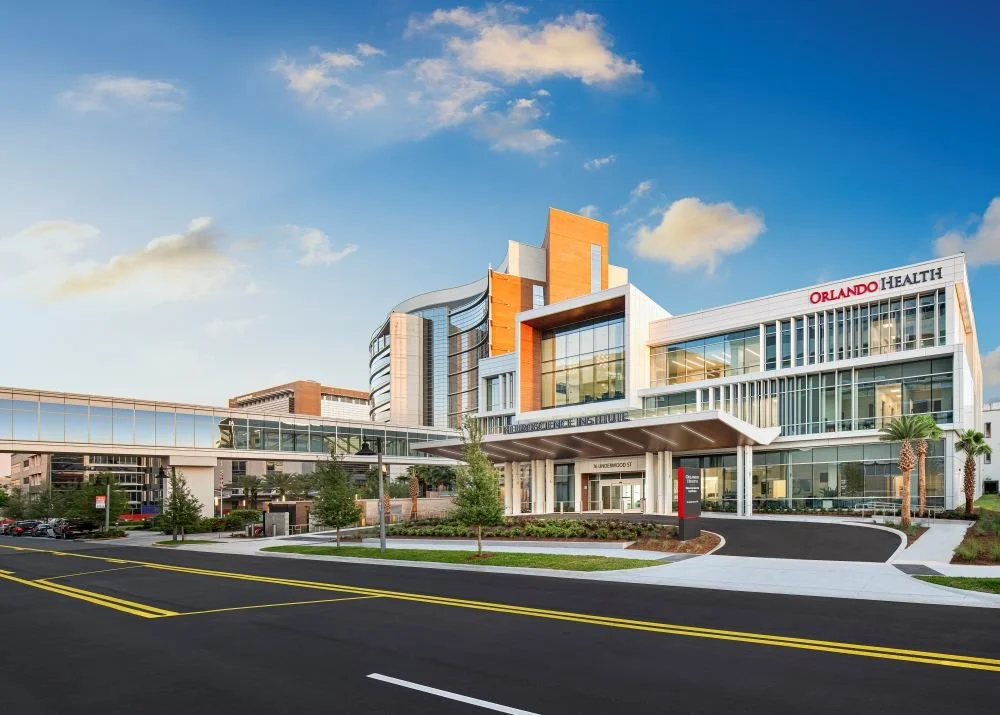
Photo by OHNI.
One Central Florida project is consolidating care in a single building in hopes that the approach will improve the lives of its patients and work of its physicians.
The Orlando Health Neuroscience Institute earned a Design-Build Institute of America (DBIA) National Award of Merit in 2025, one year after its official opening. The Haskell Company served as the engineer of record for the project, which brings seven neuroscience specialties into one space to improve clinical workflows and increase staff time with patients, who are able to visit one convenient location instead of multiple buildings.
Project stakeholders, designers, engineers and the construction team collaborated to create an integrated, communication-driven environment that ensured the three story, 45,000-square-foot building stayed on budget at $26.4 million and on schedule, finishing in just over 13 months.
“This project was Orlando Health’s first major healthcare project delivered via design-
build, and the approach proved to be very successful,” said Arnulfo Castillo, senior director of design and asset strategy at Orlando Health. “The recognition from the DBIA underscores the value of collaboration and innovation on a project of this scale and complexity.”
Sustainability and Communication at the Center
The project team had to navigate a tight urban footprint, active medical campus logistics and supply chain constraints to complete it. Coordination between Orlando Health and Haskell was imperative to complete the demolition and material delivery, both of which required precise
sequencing and staging. In addition, the project team secured early procurement of long-lead items, such as the center’s prefabricated exterior wall system, to keep the project moving forward.
In the feasibility and early programming phases of the project, the project team held robust stakeholder engagement opportunities. Physicians and operational leaders participated in visioning sessions to develop project goals and brainstorm design drivers. Evident in the building and its design, core elements reflect the neurological system and the activity between synapses.
Sustainability was incorporated into a point system that consolidated LEED 4.0, LEED for Healthcare, the WELL Building Standard, Green Globes, and the Living Building Challenge rating systems into the project. The design team tabbed Orlando Health’s Energy and Sustainability Task Force to reduce energy consumption by 15 percent.
The project included the integration of high performance building insulation in walls and roof systems and high performance glazing.
Additionally, the Neuroscience Institute has a north-oriented, main entry curtain glass wall that allows natural daylight while reducing heat gain, as well as a system that integrates with the building’s interior lighting to dim lights at times of higher natural light to reduce electric costs. The Neuroscience Institute’s interior flooring and materials were made with post-consumer recycled content, and all interior paint contains no volatile organic compounds (VOCs).
Sharing a Roof
Today, the Orlando Health Neuroscience Institute sits among Orlando Health’s Heart & Vascular Institute, Digestive Health Institute, Orthopedic Institute and Cancer Institute, which complete “Institute Row” on West Underwood Street.
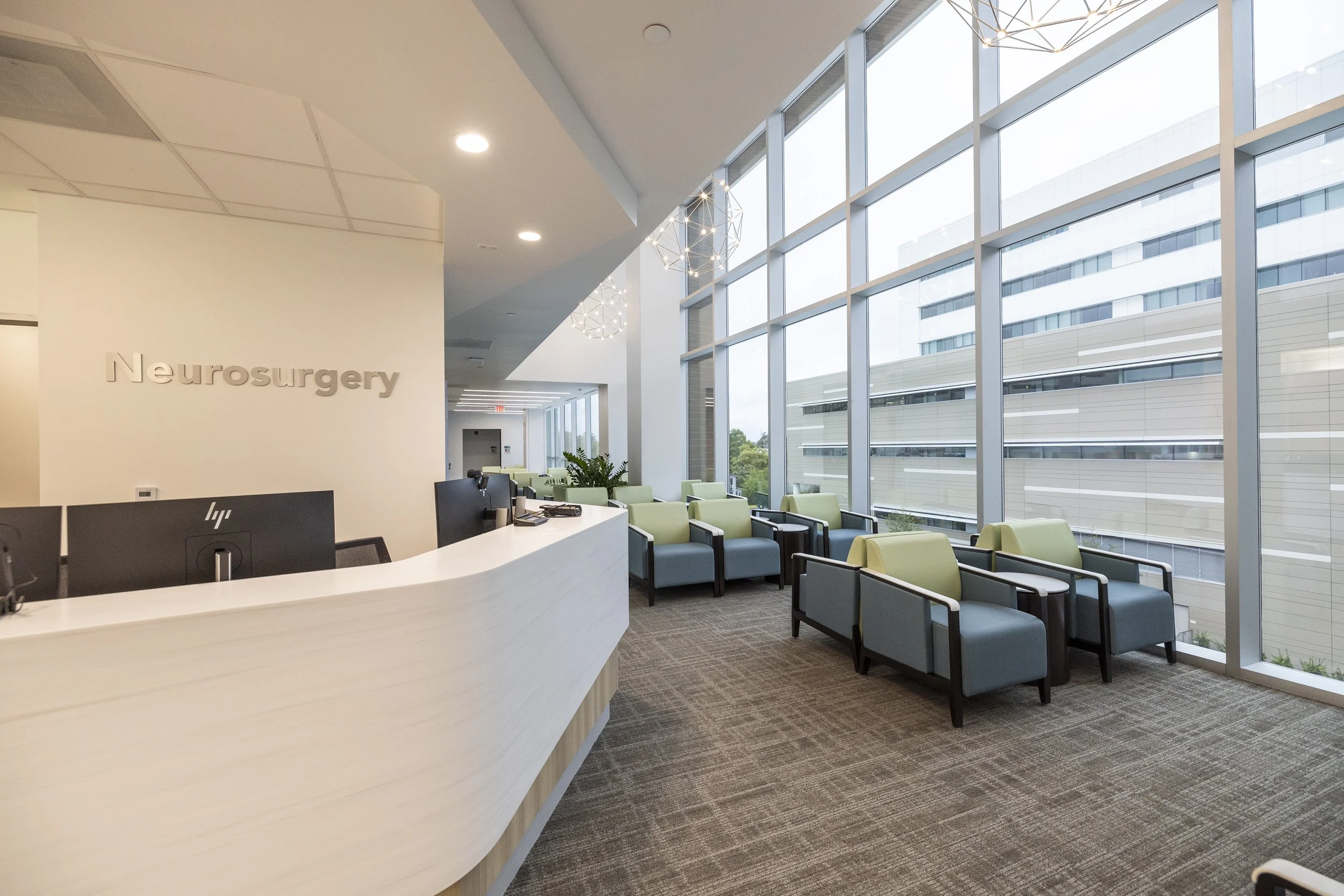
The space itself includes 19 neurology exam rooms, a treatment room for procedures and a consultation room for the memory disorder clinic, along with an Electroencephalography (EEG) reading room, 5 neurodiagnostic rooms and a lecture hall. It also serves as a primary location for the new Orlando Health Spine Center.
The new facility effectively streamlines neurological care by bringing neurosurgery, neurology, interventional spine and pain, neurodiagnostics and outpatient rehabilitation to the same building.
“Patients receiving care at our institute experience highly specialized care through our multidisciplinary approach to care and access to cutting-edge treatments,” said Christopher Thibault, assistant vice president of the Orlando Health Neuroscience Institute. “The Institute’s collaborative spaces and multidisciplinary clinics allow our providers to navigate our patients through their care from diagnosis to treatment to recovery.”
More than 50 physicians and 50 advanced care providers call the Neuroscience Institute home, while they perform more than 2,000 surgeries and multiple clinical trials each year. With many connected and overlapping specialties – from neurosurgery and neurology to neurodiagnostics and interventional spine and pain management – patients can receive integrated care for ailments across the spectrum.
Institute physicians complete minimally invasive and complex spine, endovascular procedures and other surgeries while treating a diverse range of disorders. Epilepsy, multiple sclerosis, muscular dystrophy, Alzheimer’s, Parkinson’s disease and brain and spinal tumors can all be treated in the facility.
While the building has received recognition for its sustainability features and consolidatory functions, Orlando Health leaders hope the Neuroscience Institute’s impact supersedes that of its engineering feats.
“For the community, the institute is a beacon of Orlando Health’s commitment to raising the level of care that neuroscience patients receive in Florida,” said Thibault. “For our providers, it is a catalyst for inspiration and advancement, and for our patients, it inspires hope.”